Lost Treasures
Tetsuo II: Body Hammer (1992)
Directed by Shinya Tsukamoto
"As the city grows bigger, it seems that people re-evolve, lose touch with their bodies, become disembodied almost, live only through their brains." -- director, Shinya Tsukamoto
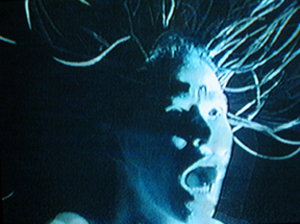
"Tetsuo II: Body Hammer" (aka "Beauty in Destruction") is the follow-up of Shinya Tsukamoto's 1988 film "Tetsuo: Ironman", and isn't so much a sequel as a redo with a bigger budget and more plot. The original was shot in grainy black & white with a story involving the transformation of an ordinary man into a monsterous machine, induced by a mysterious accident. Most often these two films are compared to the work of David Lynch or David Cronenberg (imagine "Eraserhead" meets "Videodrome". Aaaahhh!). Perhaps a better description is to say it's a modern Frankenstein fable (like Verhoeven's "RoboCop") seen through the filter of Japanese culture. In this world view, there is no mad Doctor Frankenstein, no single person responsible for the genesis of this monster. It is simply modern technology transforming, and unleashing, a new breed of human capable of mass destruction. In "Tetsuo II", the monster is the logical end product of the modern, industrialized world.
In this view, the transformation of man into machine is a natural outcome of humanity living in an unnatural, mechanical environment. Some manga/anime fans that I know have pointed out that "Tetsuo" is just a live action version of the genre, but that's like saying a live action version of Bambi wouldn't be fundamentally different from the animated one. Form not only follows, but affects content, and the reaction it provokes. A novel's treatment of the Lincoln assassination is very different from a poem about the same event. Live action, even when it's sometimes animated, has a "reality" that traditional animation does not.
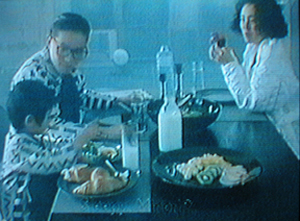
"Tetsuo II's" plot is centered on a milquetoast-nancy named Tomoo (Tomoroh Taguchi) and his downward spiral into mechanized insanity. Tomoo is a wimpy businessman with a wife and son. He wears the same thick rimmed glasses favored by Buddy Holly, and a strong breeze would knock him over. His wife, Kana (Nobu Kanaoka), on the other hand, is more physically and emotionally strong. The quick sketch of this nuclear family could be described as "Japanese Gothic". There's something austere, mysterious and off-kilter in its makeup.
At this point things get really weird. While shopping in a mall, the family is attacked by a couple of techno-cyber punks. Their little son is kidnapped and a chase ensues that finishes on a skyscraper's roof. After a struggle, Tomoo and Kana recover their child. It's not that Tomoo and Kana win the battle so much as the techno-cyber punks let them have their kid back. The purpose of this confrontation seems to be to trigger Tomoo's transformation from scrawny wimp into metallic doomsday machine. This encounter reawakens the rage that has been slumbering within.
As we later learn, Tomoo's unremembered past isn't a peaceful one. The techno-cyber punks soon reappear and snatch the boy from the couple's home. During this second attack, Tomoo begins his physical transformation into a cyborg killing machine. His hands become mini-cannons, and his muscles start to be replaced by wires and tubes. The kidnappers use the boy as a shield. In an uncontrollable rage, he ends up killing his son.
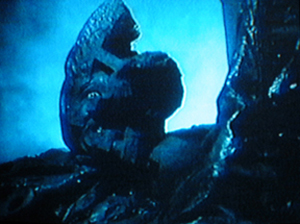
There is no return from insanity for Tomoo after the death of his son. The eerie and disturbing imagery quickly multiplies. Phallic pipes erupt from his torso and chunky blocks of armor plating cover his body until Tomoo looks like a diesel fueled Gumby-from-hell. He even incorporates the techno-cyber punks into his growing, mechanical body. Many of these sequences are animated, using the actors and bits of scrap metal. Sometimes we see Tomoo in time-lapse photography, standing still as the people of the city flow around him. Another technique used is under-cranking the camera and cross-dissolving the images, which results in a nice trippy effect.
Unlike the original "Tetsuo", "Tetsuo II" is in color, but the color is often just muted grays and blues. A few sequences involve a blast furnace that exists somewhere in the punk's lair. These scenes are glowing orange, like they exist in the pit of hell. Forget the plot. The visuals tell the whole story here. There is no CGI gimmickry, and "Tetsuo" looks like few other films you have ever seen. The Lynch/Cronenberg analogy breaks down. The lesser known work of Czechoslovakian animator Jan Svankmajer ("Alice", "Faust") is more apt. Both "Tetsuo" films are unique and stand on their own robot-monster feet. They were made over a decade ago, but Shinya Tsukamoto's films have retained their power to transport you to the bizarro-world, if you don't mind the trip. "Tetsuo II" is for those who want something different... very different.
One last point, I have to bring up the issue of sadism and sex in Far East movies. If you've ever seen "In the Realm of the Senses" then you know what I'm talking about. "In the Realm of the Senses" is an extreme example but there's a little bit of that movie in many other Japanese films that aren't specifically about power and sex. In "Senses", an obsessed couple engages in more and more twisted acts until the stomach-churning castration scene at the end.
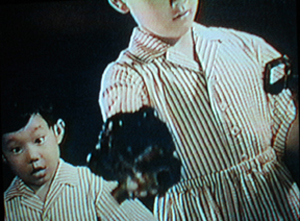
In "Tetsuo II", a young Tomoo and his little brother witness their parent's involvement in some very weird behavior. Their creepy father uses a cocked revolver to heighten the sexual experience. It's not clear if their mother is a willing participant in this bizarre and incredibly dangerous game. At one point, their father pushes the barrel of the gun into her mouth. Your skin will crawl as her teeth makes a scraping sound against the gun's barrel while they hump.
I don't have enough knowledge of Japanese culture to pretend to give insight into the underpinnings of these recurrent and disturbing images of sexual abuse. They obviously betray male anxiety over the independence of women and the desire to control them, by no means a specifically Japanese phenomenon. Other reviewers tend to ignore these elements in their treatment of Japanese, and to a lesser degree, Hong Kong cinema, but I can't imagine this happening if the same shit cropped up in an American film.
One fairly recent American movie (by a Canadian) did push into this territory and that was "Crash", which was directed by, surprise-surprise, David Cronenberg. However, "Crash" was sexually bizarre but not really sadistic (masochistic perhaps). That didn't stop New Line Cinema from running in terror from its role as the promoter and distributor of "Crash". There is a place in movies for these ideas to be discussed but the point I want to make is that often they aren't. In the case of "Crash", most reviewers tended to simply express their outrage and call on the reader to avoid the offending movie. I'm going the other way: Check out "Tetsuo: Ironman" & "Bodyhammer"... or "Crash"! What does it all mean? Let me know when you figure it out.
Tom Graney -- copyright 2003 Hollywood Outsider