Lost Treasures
On the Beach (1959)
Directed by Stanley Kramer
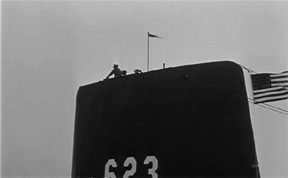
In 1959 Stanly Kramer produced and directed an off-beat movie called "On the Beach"; a film distributed by United Artists. U.A. was the Miramax of its day; a studio/distributor that tried to blend art with commercialism. The plot of "On the Beach" is simple. It takes place 5 years in the future (1964) and a nuclear war has rendered the whole of the northern hemisphere of planet Earth dead from lethal radioactive fallout. Australia is the only place that is left inhabitable... at least for the moment. Surviving scientists predict that the radioactive shroud enveloping the globe will reach Down Under shortly and kill what's left of the human race. Surprisingly, an American nuclear submarine, The Sawfish, turns up in Melbourne Harbor and we witness humanity's last months through the eyes of the U-boat's commander and the Aussies who befriend him. Unlike other nuclear holocaust movies, "On the Beach" depicts humanity's ending... our ending... not with a dramatic bang of fire and ice, but with a radioactive whimper that's full of melancholy.
In "On the Beach", the character's try to carry on with their lives in the face of the bleakest of prospects. In this vision of the apocalypse, social chaos does not ensue. The few survivors are not at each other's throats over the remaining resources. It is a very different vision of the-end-the-world than what is usually depicted in movies with a similar premise. Renegades are not battling in the badlands over "a tank of juice" ("The Road Warrior" 1981), or for control of the few remaining fertile men and women ("A Boy and His Dog" 1975), or primate supremacy ("Planet of the Apes" 1968).
All these movies are classics, but they envision a very different, and exciting, action filled ending to the human story than the one pictured in "On the Beach." A more subtle finish, though unusual, is not necessarily less realistic. Perhaps, it's more poignant, even sensible, to think that people would carry on with their lives, regardless of the prospects. Consider the musicians on The Titanic, they really did continue to perform until the water was literally rising around their ankles. They could have spent their last moments running around, screaming and pulling their hair out, but what would have been the point? What could be more comforting than pursuing life-long passions even in the face of oblivion? Wouldn't many of us stay true those things and people we love most? Wouldn't we continue to pursue romance, or even fulfilling unrealized dreams? Wouldn't we want to "seize the day" in the face of oblivion? Is this an affirmation of life, or a tacit acknowledgement of mortality?
Evidently, Stanley Kramer felt that "On the Beach" was an important film, a memento mori for the atomic age. It helps to keep in mind that it predates the Cuban Missile Crisis (October 1962) by 3 years, which was the closest that The Cold War ever came to becoming hot, much closer to the reality depicted in "On the Beach" than anyone would care to dwell on today. The social relevance of "On the Beach," or captured historic mood, is not the reason why it has been selected as a "Lost Treasure," nor its oft annoying Oscar nominated score, nor its use of Gregory Peck, Ava Gardner, and Fred Astaire as "average joes." It's a "Lost Treasure" because of its characters' unique approach to the meaning of life, or more accurately, living, that is as relevant today as it was in 1959.

We are all faced with the same eventuality. The folk depicted in "On the Beach" (most of whom have since died) are forced to confront their impending mortality. They are simply more aware of this fact than you or I. A fairly recent movie to take a similar view is Don McKellar's "Last Night," but rather than condensing the action into the final few hours (with the attendant drama of a count down), "On the Beach" depicts a rather un-dramatic length of time, as the character's carry on with the business of their lives. Seen here, the last moments of the human race are achingly ephemeral.
The plot revolves around two couples; Anthony Perkins as Lieutenant Commander Peter Holmes of the Australian Navy and Donna Andersen as his wife (Mary); who is a new mother. Gregory Peck plays the Commander of the U.S. nuclear submarine Sawfish, Dwight Lionel Towers, and Ava Gardner is his boozy would-be lover, Moira Davidson. Anthony Perkins gets one of his great screen roles, ranked only after "Fear Strikes Out" and "Psycho," doing what he did best; portrayals of characters who hide their inner turmoil under a mask of serenity. In "On the Beach," Peter is a helpless husband and father who knows that radiation sickness and death is in his family's not too distant future. On the flip side, his wife, Mary, is in denial, unable to accept the fact that their baby daughter will never get the chance to grow up. Mirroring Mary's denial is the sub's commander, Dwight; prepared to die in war but unprepared to survive a war that has claimed the lives of his wife and children. When Mary learns that Peter has invited the American to a weekend party, she is peeved at the thought that he might get drunk and start crying. Beautiful party-girl, Moira, is invited to chaperon and distract the grieving widower.
The movie is dated in its attitudes about sex and romance. Luckily, the swelling violins of the romantic scenes are snapped by Dwight's bizarre habit of speaking of his loved and lost, not only in the present tense, but in the future tense. Moira says nothing and just listens in uncomfortable silence. Peck is great as he turns in another one of his patented dark, silent and brooding characters. However, in "On the Beach," he occasionally rhapsodizes over the futures that his nuked family will never have. It's very creepy.
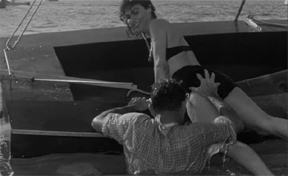
Ava Gardner has the toughest role in the film portraying Moira, a woman whose shallow relationships with men have left her emotionally empty. This emptiness she tries to fill by drowning herself in alcohol. To Moira, Dwight represents a last chance at having a meaningful relationship. Unfortunately for her, it quickly becomes apparent that Dwight is in no shape to play his part in the romance. Moira's self-esteem is pretty low and she confesses that, "I don't like myself very much, anyway." It's tough for an audience to like a character that doesn't like herself. On the other hand, it's Ava Gardener for Christ's sake. It doesn't take too much to feel empathy for her. Good casting choice!
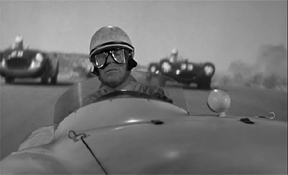
Fred Astaire plays a scientist that wants to realize an unfilled dream before it's all over. He spends a good bit of his time tinkering with a Ferrari that he intends to race in the planet's last Grand Prix. The car race itself is mostly rear-screen projection of peanut-head Astaire as he battles with his fellow racers for the finish line. It's a deadly competition with lots of fiery crashes. It almost seems comical when an ambulance speeds out to check for smoking survivors of a multi-car pileup. There's an antagonistic tone in the film about the role and responsibility of scientists in this Armageddon. Interestingly enough, no one ever turns on the American nuclear sub commander with an accusatory comment about what he was doing during the extinction of the human race. To its credit, the film doesn't take the easy road of assigning blame to the Soviets or Americans. It's all hazy. The war happened quickly and those that would know the sequence of events have been obliterated.
The best part of the film involves The Sawfish's new mission to investigate the northern climate's effect on the radiation levels and a mysterious Morris Code signal originating from San Diego. The journey north is eerie. They steam under the Golden Gate Bridge and observe a ghost town that was San Francisco. One of the crew members jumps ship in order to die on his home turf. This entire sequence of the film is handled in a surprisingly understated way. It carries a lot of emotional weight and may be one of the best sequences to capture the sad fact that humanity has a large self-destructive streak. The scene where they finally discover the sender of the Morris Code signal in San Diego is a classic movie moment. If for no other reason, it's a good reason to check out this flick.
Tom Graney - copyright 2003