Lost Treasures
Flirting (1990)
Directed by John Duigan
"I don’t think fate is a creature or a lady like some people say. It’s a tide of events sweeping us along. I’m not a fatalist because I think you can swim against it, sometimes grasp the hands of the clock-face and steal a few precious minutes. If you don't, you just cartwheel along. Before you know it, the magic moment is lost... and you're just left with what might have been." So says and lives Danny Eh-Eh-Embling (Noah Taylor), the stuttering outsider at an all-boy prep school in John Duigan's "Flirting"(1990).
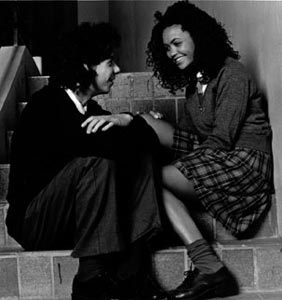
Danny's existence is a little grim. It's the early 1960's and the prep school he's attending is run like a weird blend of Alcatraz and a Ms. Manner's charm school. Danny doesn't feel sorry for himself, though. The beatings from teachers and verbal abuses from fellow students are dispensed as a matter of routine and Danny handles it with razor sharp humor. He's a smart kid and he takes comfort inside his head. He reads constantly, mostly heavy intellectual stuff like Sartre and Marx, but he also likes Cassius Clay's (bka Muhammad Ali) poetry. Also, he thinks wistfully of the all-girl prep school that sits across a lake from the boys' school -- the buildings facing each other, "like two brooding volcanoes".
At the girls' school there is a new inmate, Thandiwe Adjewa (Thandie Newton), who arrived in the middle of night. When she wakes the next morning, a crowd of staring fellow students greets her. Evidently, they have never seen a black woman before. Finally one of them asks, "Anyone got a banana?", and that's as close to a welcome as she will ever get. Colonialism and white supremacy are thick in the Australian air of the early 1960's. These are the sons and daughters of the English colonizers of a "wild" continent and the aborigines are mostly viewed as savage primitives. But Thandiwe is not Australian. She's from the newly independent African nation of Uganda, a place that her fellow classmates have never heard of, or are even remotely curious about.
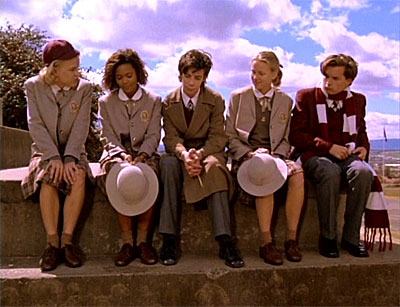
Both Danny and Thandiwe's fortunes change for the better during a debate held between the boys' and girls' schools. The position of the faculty is that, "Intellectual pursuits are the highest form of human endeavor". The girls are to argue the pro position and the boys to argue the con. It's a fixed game and nothing more is expected than that the students come to the civilized conclusion that intellectual pursuits are more important than physical desires.
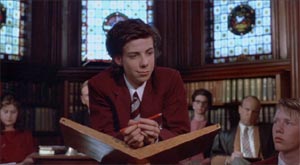
The whole thing is ho-hum until Danny gives an eloquent speech (stuttered, of course) on why Australian football is one of the "ha-ha-highest forms of hu-hu-human endeavor". When Thandiwe's turn comes, she switches sides and also argues the merits of physical pleasure. She points out that contemporary artists are more interested in "bodily functions" than intellectual pursuits, to the horror of the teachers running the debate. She goes on to recite Little Richard's "Tutti Frutti" as a way of illustrating the point. "I don't want you toast my bread. I don't want you make my bed. I don't want your money, too. I just want to make love to you... A Womp Bop a Lou Bop, A Bop Bam Boom". It's at this point that Thandiwe and Danny form a mutual admiration club.
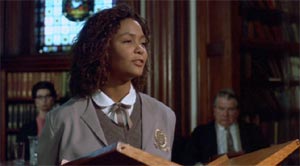
Despite Thandiwe and Danny’s outsider status, the story isn't really about how they become their own little club or clique. It's really about how it's a big world full of all kinds of people and ideas. At some point, we all encounter the bigger world and have our fundamental assumptions about life challenged. Some people react with fear and seek refuge in their religion, their class and/or their race as a way of coming up with quick, easy and comforting answers. As Danny observes, "People wonder how Hitler managed to get so many followers. It never surprised me".
But some people react with curiosity and have their ideas broadened. Danny, Thandiwe and their friends belong to this other group. It's through their relationship that Danny and Thandiwe grow. Danny’s friend, Gilby (Bartholomew Rose), advises him that, "They can be pretty desperate, these black women. Just look at National Geographic". This starts Danny thinking about National Geographic and Hollywood movies like "Tarzan" and he realizes that he doesn't really know anything about Africa or Africans. Even in the insular world of a prep school (as portrayed here), Danny comes to realize that there, "were much bigger worlds and some small place in them for me".
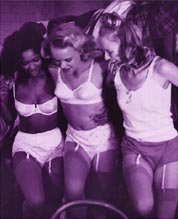
"Flirting" is the sequel to "The Year My Voice Broke" (1987) and is one of the few follow-ups to be even better than its predecessor ("Godfather 2" jumps to mind. Move over "Kane", "Godfather 2" IS America's greatest film). "Flirting" is also distinctive because it starred three relatively unknown actors who have gone on to recognition the world over. Noah Taylor played the young David Helfgott in "Shine" (1996), Nicole Kidman went on to be the ex-Mrs. Tom Cruise (which I salute her for), "HO's" "Babe of the Month", Thandie Newton, stars in this summer's "Mission Impossible 2" (she's gettin' paid), and Naomi Watts is going to be in the next David Lynch flick.
It's interesting how, every once in a while, a brilliant little movie comes out with basically unknown actors that, as the years pass, turns out to be an "all star" cast (Sort of like John Boorman's "Excalibur" which had Helen Mirren, Patrick Stewart, Gabriel Byrne and Liam Neeson, none of whom were well known in the United States in 1981). Despite the heavy handed dissecting of "Flirting's" themes in this column, John Duigan's direction is light as a feather and the tone is that of a sweet comedy. After seeing "Flirting", you'll be thinking about how nothing is destined and that taking little actions, even if it's just flirting with someone special, can change your whole life.
Tom Graney -- Hollywood Outsider 2001