Lost Treasures
The Duellist (1977)
Directed by Ridley Scott
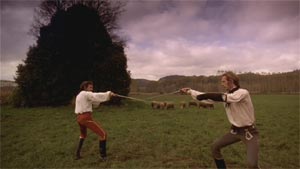
A thirty-year obsession of savage duels-to-the-death sparked by an imagined insult could only come from a true story. Joseph Conrad ("Heart of Darkness") wrote "The Duel" about two real life officers during the Napoleonic War. It is an eccentric tale of a ludicrous dispute and vendetta between two noblemen soldiers over the course of their adult lives that nearly consumes them both. "The Duellists" (1977) is the directorial debut of Ridley Scott ("Alien", "Blade Runner", "Thelma & Louise") and began an eclectic career for the ex-commercial director. Can you say, "G.I. Jane"? Keith Carradine stars as French soldier Armand d’Hubert (try imagining that one) and Harvey Keitel is Lieutenant Gabriel Feraud (New York accent et all) a fellow officer who become wrapped up in a war of words, honor and sabers.
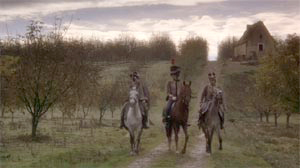
A beautiful and haunting theme introduces a lame voice over that starts up the story beginning in 1800, the year Napoleon became the ruler of France. Scott delivers with his quintessential every-shot-is-a-Caravaggio-painting style of filmmaking. D'Hubert is sent to tell Feraud that he is under house arrest for fighting a duel in the morning and must return from his mistress' side. A clear insult and breach of honor and manhood(?). This act sets in motion the dueling warriors. A wonderful parallel is created through the reflection of this personal battle and the rein of Napoleon. Feraud does everything he can for his emperor while trying to destroy d'Hubert whose loyalties waver. At one point Keitel even looks like Napoleon! Subtlety with a sledgehammer.
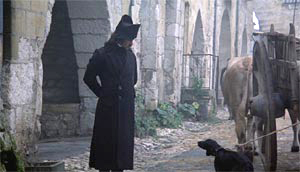
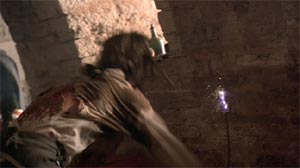
Each duel through the years is more heated than the last. The subtext of the power struggles of France are mirrored in each challenge. How didactic! Sometimes it is hard to believe in the "French" nobility of these two gentlemen when everyone around them has British accents and they just stumble along butchering the dialogue at every turn. The exhausting duel in the cavern/stable/basement(?) is one of the most brutal and the best. A steady stream of sunlight flickers in with the HMI light in the background as the two battle it out and blood streams everywhere. Scott had the sabers wired with batteries to produce sparks. Keitel complained about being heavily shocked more than once.
As the two move up in the ranks together, thus allowing them to continue the ongoing duels, a strange "friendship" is produced. D'Hubert on more than one occasion tries to bury the hatchet but Feraud will have none of it. This is where the queer homo-erotic connection is made between the effeminate Carradine and the too-tough-for-words Keitel. Harvey's bizarre attraction to Keith is a classic example of homophobia.
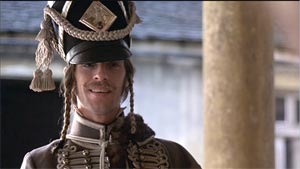
It is an exoticly cold and moody film steeped in misty morning light. And that brings us to the string of graduated filter shots. And boy, when they start getting used, look out! A graduated filter is a piece of glass that fits on a camera lens with the top half being a dark color and slowly lightens up like a pair of cheap sunglasses. In viewing some of these beauties I wondered if the assistant cameraman couldn't loosen the damn thing and just left it on the lens for the rest of the shoot. Especially bizarre are the pan shots across buildings, trees and mountains ranges. During the mid-seventies in British television these were probably the rage, but in modern cinema you wonder what could they have been thinking. The strange thing is many cinematography books use "The Duellists" as an example of great motion picture photography. I agree as long as an asterisk can be added about those damn filters.
Okay, off the soapbox. The movie boasts the appearance of Albert Finney among the stars. Appearance is a good word, he's in one scene! Tom Conti shines as the flute playing doctor, Jacquin. Pete Postlethwaite (credited as Peter) has a small cameo as the "Man shaving Gen. Treillard" (hey, we all have to start somewhere). The film garnered Ridley Scott with the Best First Work prize at the Cannes International Film Festival in 1977.
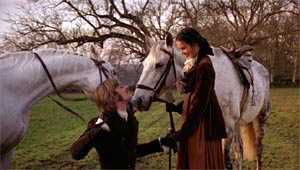
So, where the hell did I leave off. Oh, now d'Hubert and Ferard are still dueling it out year after year, decade after decade. Scott (or rather Conrad) gives us the future of France as the willing-to-forgive Carradine gets married and starts a family, while the embittered Keitel sulks and is sentenced to death for his loyalty to Napoleon. In one of the most striking moments, Carradine using his clout saves Keitel from the guillotine with the one request that he is never told who saved his life. This poignant personal gesture is rewarded with the lunatic Keitel forcing Carradine into one final duel. You'll just have to go out and rent this one to find out how it all gets resolved.
Guido Sanchez -- copyright 1999